


250 years of Lodge Cambuslang Royal Arch Lodge No. 114
Origins in the Seventeen Hundreds (1735–1799)
Freemasonry had been practised in the Cambuslang area and within the town itself for many years before the formation of Cambuslang Royal Arch Lodge. Operative Freemasonry was already established, and a charter issued by Mother Kilwinning in 1735 named the lodge the “Cambuslang and Blantyre Lodge”. For reasons now lost, in 1737 those Masons involved applied to Kilwinning for a new charter, which was granted in 1738. Known as the “East Kilbride” Charter, it covered East Kilbride, Cambuslang, Carmunnock, and Blantyre.
Lodge meetings were held in various dwellings and the charter was kept at Hallside House. A minute of a meeting held in 1767 under the old charter is recorded in the history of the first 200 years.
Cambuslang Royal Arch Lodge emerged from this ancestry in 1769, when our existing charter was granted by The Grand Lodge of Scotland on 17th February. The original lodge number was 146; our familiar number 114 was issued when Grand Lodge renumbered all lodges within its jurisdiction. The first meeting under the new charter was held on 23rd February with Bro. Ingram Whyte as RWM—Brother Whyte, previously Junior Warden in the Kilwinning chartered lodge, had travelled to Edinburgh to request the charter from Grand Lodge.
Until 1799, the Lodge operated using the bye-laws from the Kilwinning charter, when new bye-laws were agreed—the principal difference being the change of the Annual Festival date from St John’s Day (7th January) to 27th December. At this time, the Lodge Master had to be an Operative Freemason, and Operative and Non-Operative Masons paid different initiation fees. Old minutes also refer to the Lodge chest in which jewels, money, and minutes were secured by three keys held by the Master and Wardens (likely the chest lost in the basement flood of the mid-1980s).
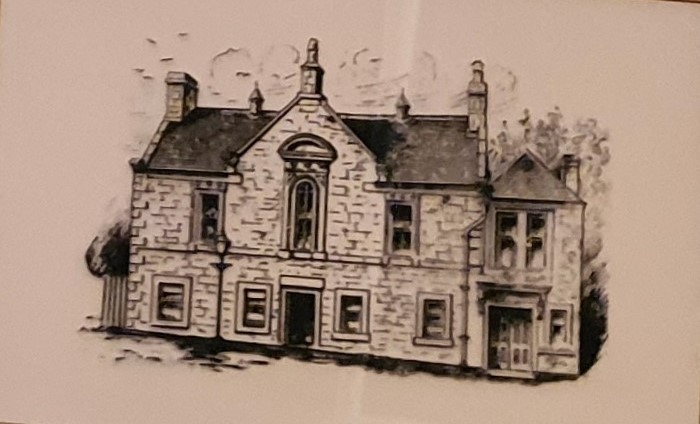
In 1777, the first Non-Operative Mason, Brother John Hamilton, was elected as RWM and granted the Lodge land in Kirkhill to build a permanent meeting place. Each member agreed to give six days’ labour of his own hands—or pay for another to work the same period—to erect the building on what is now Cadoc Street, almost directly across from where the Kirkhill Bar stands today. Consisting of two storeys and an attic housing shops and a Lodge room, the building cost a total of £162, 10 shillings, and ¾d, and held its first meeting in July 1778.
Office Bearers at this time comprised only the Master and his Wardens, the Clerk (Secretary), the Collector (Treasurer), the Stewards, and the Tyler. Lodge records note that from 1775 the Lodge fell under the jurisdiction of the Provincial Grand Lodge of Lanark, Renfrew and Ayr, before moving to the Provincial Grand Lodge of the Western District in 1795.
The Early Eighteen Hundreds (1800–1899)
Compared to its formative decades, the Lodge enjoyed a quieter period settling into its Kirkhill home, though much discussion centred on penalties for absence and non-payment of fees—the most serious penalty being expulsion after three years of non-payment if the member lived within 20 miles of Cambuslang Kirk.
The Lodge commissioned its first Lodge Banner in 1810, which was carried at the laying of the foundation stone of the new Lodge in Hamilton. This original banner was replaced in 1835, and the new banner featured prominently at the laying of the foundation stone of Jamaica Bridge in Glasgow. While it is not certain which of the two banners sits in the display cabinet in the Lodge room today, restoration work by Colin Hunter McQueen points to the older 1810 banner. Our origins from the older Kilwinning Charter were also formally averred in the minute celebrating the Lodge centenary in 1835.
During this era, the Lodge sat in the Province of the Upper Ward of Lanarkshire before moving into the newly formed Province of Lanarkshire Middle Ward under its original number 146. Notably, several Masters served multiple terms during these decades—Bro. John Glen served as RWM for two separate four-year terms, two separate two-year terms, and one single term.
The Kirkhill building was upgraded during this period at a cost of just over £500, converting the ground floor from shops into domestic accommodation. Around the same time, the Lodge began conferring the Mark ceremony—having previously worked only the three Craft degrees—and acquired the Mark Master Keystones still in use today, gifted by Encampment No. 3 of Glasgow when it ceased operation prior to Encampments being absorbed into The Great Priory of Scotland.
Little mention is made of Provincial Grand Lodge until 1866, when Lodge Hamilton Kilwinning No. 7 convened a meeting—attended by 114—to re-awaken the Middle Ward Province into active service. That same year, the Lodge resolved to be represented directly in Grand Lodge by its Master and Wardens rather than relying on Proxy Masters to avoid travelling to Edinburgh (one Proxy, John Henderson, had represented the Lodge for 27 years).
Later milestones of the century included:
- 1876: The “Burns” stained glass window—currently set in the stair window—was commissioned.
- 22nd September 1889: The first recorded Masonic Divine Service held by No. 114 took place in the West Parish Church with an attendance exceeding 200 (unlike our modern practice of holding the service close to our February charter date).
- Historic Regalia: Treasurer’s books from the era also record purchases of Office Bearers’ sashes and a brief mention of Deacons’ rods—items long assumed never to have been worn or used by No. 114.
The Twentieth Century: Moving to Our Present Hall (1900–1969)
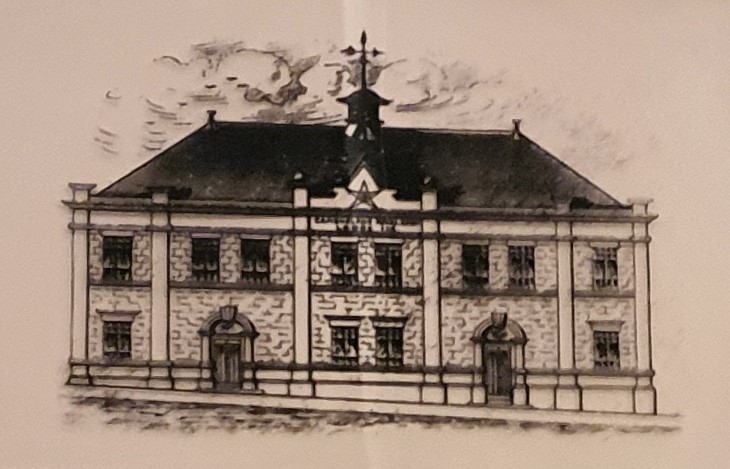
The new century opened with RWM Bro. John Wallace leading discussions on whether the Kirkhill premises could accommodate our growing membership. Having occupied Kirkhill for 125 years, the decision to move further into town was not taken lightly, but the Lodge agreed to acquire land in Tabernacle Lane and erect our present premises. The old building was sold for £600, and our new Lodge opened in 1904, funded through member fundraising and generous gifts. During this period, the RWM also read an obituary for Past Master John Glen Dunn, who was installed in 1897 and served faithfully until his passing at the age of 101.
Several Brethren who helped erect the new hall were tragically lost in the Great War of 1914–1918, commemorated on the memorial plaque on the west wall.
In 1922, Bro. Lt. Col. John Dodds JP was installed as RWM. As our installation ritual recalls, Bro. Dodds gifted the Lodge the magnificent gold chain worn by successive Masters since he became IPM.
During the Second World War, many young Masons enlisted to serve their country. Lodge business continued throughout the war, with minutes recording heartfelt thanks to Brethren from neighbouring lodges who stepped in to perform degree work while our own members were on active service. A prominent figure of this era was Bro. Frank Elliot Dobbie, who became a Provincial Grand Commissioned Office Bearer in Glasgow and Substitute Grand Master Mason, yet never neglected his Mother Lodge and attended our annual installations regularly.
Other distinguished Brethren of this period include our three Past Provincial Senior Wardens—Bro. James Buchanan (1925), Bro. Ralph Sillars (1939), and Bro. William Kennedy (1960), who also served on the Board of Grand Stewards—followed in Provincial Grand Lodge by PM Robert Russell (PGL Secretary), PM Frank Moug (Almoner), PM Angus Ross (SPGM), PM Laird McDonald (SPGM), PM Gordon Hope, and PM William Spencer (Grand Lodge Stewards).
Present Day
Having weathered the challenges of the pandemic and returned to full Masonic labour—marking the second term in the chair of Bro. James Richardson and the installation of Bro. John Chambers—Lodge Cambuslang Royal Arch No. 114 continues to uphold over two and a half centuries of Craft tradition in the heart of Cambuslang.